
In the UAE, dredging projects rarely fail because of a lack of equipment. They fail because the wrong dredging setup is selected for the site. Factors like restricted access, variable sand conditions, shallow coastal zones, inland canals, and tight project timelines make equipment selection critical. This is why the choice between excavator-mounted dredges and submersible dredging pumps UAE contractors rely on needs careful evaluation.
Both options are widely used across UAE dredging projects, but they solve different operational problems. Excavator-mounted systems offer high control and flexibility in nearshore and confined areas, while submersible solutions provide steady performance in deeper or continuously flooded zones. Understanding where each system performs best helps reduce downtime, control wear, and improve output.
This blog compares these two approaches from a UAE project perspective, focusing on real site conditions rather than theory. It also explains how Pump and Dredge UAE supports contractors with the right UAE dredging pumps, system configurations, and on-ground expertise to match equipment to actual job requirements.
Start with the site, not the pump: UAE jobsite realities that decide the winner
Before choosing between excavator-mounted dredges and submersible dredging pumps UAE projects depend on, the first step is understanding the site itself. In the UAE, job conditions vary sharply even within short distances, and these conditions usually decide which dredging approach will work best.
Access is the first limiter. Many UAE dredging jobs happen along canals, shorelines, drainage corridors, or reclaimed land edges where an excavator can easily operate from firm ground. In such cases, excavator-mounted dredges allow fast setup and direct control. However, where access is limited, water levels fluctuate, or the dredging zone is fully submerged, submersible dredging pumps become the more practical option.
Material type also changes the decision. UAE projects often involve fine sand, compacted sediment, sludge, or mixed debris. Excavator dredges work well when material needs controlled cutting and precise removal. Submersible dredging pumps that UAE contractors use are better suited when material consistency changes frequently or when continuous slurry pumping is required without stopping for repositioning.
Depth and water conditions matter more than expected. Shallow projects with variable water levels favour excavator-mounted setups. Deeper zones, sumps, or flooded areas usually perform better with submersible pumps that remain fully immersed and maintain stable suction.
Timelines and productivity targets are another deciding factor. Short-duration or maintenance dredging projects often benefit from the speed and flexibility of excavator-mounted dredges. Long-running projects with steady output requirements tend to favour submersible dredging pumps due to consistent flow and reduced interruption.
This is why UAE Pump and Dredge focuses on evaluating site access, material behaviour, depth, and production goals before recommending UAE dredging pumps. Matching the pump to the site conditions, not just the project size, is what delivers reliable performance and avoids costly changes mid-project.
When excavator-mounted dredges are the fastest path to production in UAE projects
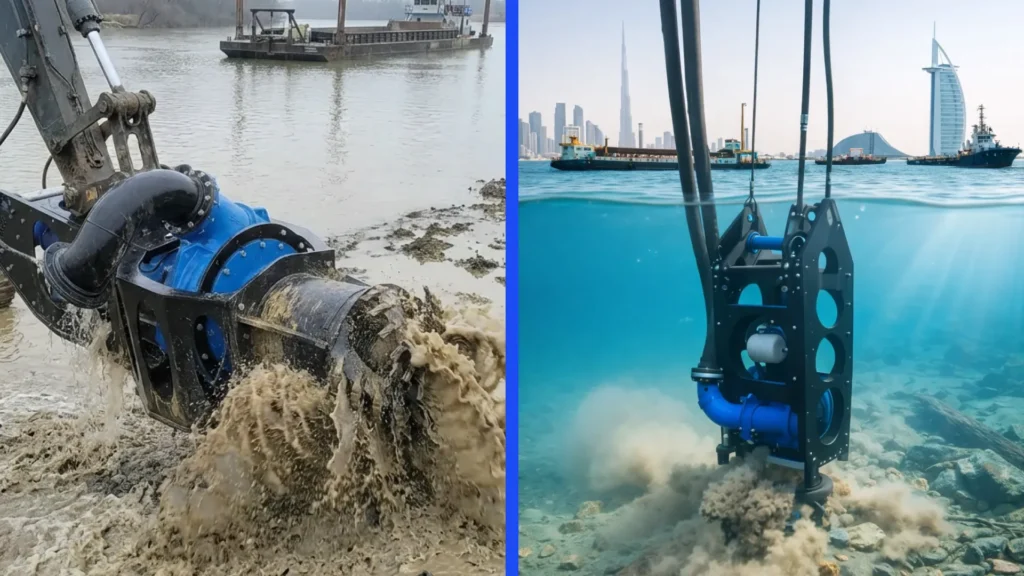
For many UAE dredging jobs, excavator dredges deliver results faster because they combine pumping power with precise material control. These systems use a dredge pump mounted on the excavator boom, allowing the operator to cut, agitate, and pump material in one continuous action.
In UAE environments, this setup works especially well where shore access is available. Canals, drainage channels, lagoons, and near-shore coastal areas often allow excavators to operate from stable ground or temporary platforms. In these cases, excavator dredges reduce the need for floating structures, making mobilization quicker and simpler.
Control is a key advantage. The excavator operator can directly manage the cut depth, swing angle, and feed rate into the pump. This is valuable in UAE projects that require selective dredging, maintenance work, or removal of compacted sand close to structures. The ability to reposition quickly also helps maintain steady production without frequent shutdowns.
From a material-handling perspective, excavator dredges perform well with dense sand, silt, and mixed sediment. Integrated agitators or cutting heads help loosen compacted material before pumping, improving solids concentration and reducing air intake. This makes them suitable for projects where material needs active excavation rather than passive suction.
UAE Pump and Dredge supports these applications with excavator-mounted pump configurations designed for high solids handling and reliable depth performance. By matching the pump, hydraulic power, and discharge setup to the excavator size and site conditions, they help contractors achieve faster output with fewer operational adjustments using proven UAE dredging pumps.
UAE dredging pumps comparison: what actually changes performance on site
Choosing between excavator dredges and submersible dredging pumps UAE projects use is not about which system is “better.” It is about which system reduces risk, downtime, and cost for that specific site. Below are the performance factors that usually make the real difference on UAE projects.
Mobilisation and setup
Excavator dredges typically mobilise faster where shore access exists. The excavator arrives, the pump is mounted, and dredging can begin with minimal additional infrastructure. Submersible dredging pumps require placement in water, discharge line routing, and sometimes floating support, but once installed, they stay productive for longer continuous runs.
Production control vs steady output
Excavator dredges give operators direct control over the cut. This is useful when accuracy matters or when material is compacted and uneven. UAE contractors focus more on maintaining a steady flow rather than precision cutting, making them better suited for uniform or continuously settling material.
Depth and suction stability
Depth affects system choice more than many expect. Excavator dredges perform best in shallow to moderate depths where boom reach is sufficient. As depth increases, suction stability becomes harder to maintain. Submersible dredging pumps, UAE teams deploy remain fully submerged, which helps maintain suction efficiency at greater depths.
Wear patterns and maintenance
Excavator-mounted systems concentrate wear around cutting and agitation components. Submersible dredging pumps experience continuous abrasive exposure, making wear-part selection and maintenance planning critical. In both cases, incorrect wear strategy is a common cause of early failure.
Manpower and safety exposure
Excavator dredges rely heavily on operator skill and machine positioning. Submersible systems reduce active handling during operation but require careful planning during installation and retrieval. Site safety planning should reflect these differences.
This comparison shows why UAE Pump and Dredge evaluates site access, depth, material behaviour, and production goals together, rather than recommending equipment in isolation. Matching the dredging method to these performance factors is what allows UAE dredging pumps to deliver reliable output across varied project conditions.
Which works best where: UAE project scenarios that guide the right choice
In the UAE, dredging equipment decisions become clearer when viewed through real project scenarios rather than technical specifications alone. Different environments place different demands on UAE dredging pumps, and understanding these patterns helps avoid costly mismatches.
Coastal and nearshore dredging
For shoreline maintenance, beach nourishment edges, and shallow coastal cleanup, excavator dredges are often the preferred option. Shore-based access allows fast repositioning, and operators can control the cut precisely to avoid over-dredging near structures. Submersible dredging pumps UAE projects in coastal zones are typically chosen only when water depth increases or access from land is restricted.
Canals, drainage corridors, and inland waterways
In canals and drainage systems, access conditions vary. Where excavators can operate along the bank, excavator dredges deliver efficient, controlled removal of settled sediment. In narrow or fully flooded sections, submersible dredging pumps that UAE contractors rely on provide continuous removal without needing frequent equipment movement.
Construction dewatering and slurry removal
Construction sites across the UAE often generate slurry with changing consistency. Submersible dredging pumps are commonly used here because they can remain in place and handle variable material without frequent adjustment. Excavator dredges are used when slurry must be removed from specific zones or pits with defined boundaries.
Mining, industrial, and abrasive material handling
For abrasive slurry or high-solids sand, excavator dredges perform well when active cutting is required to break compacted material. Submersible dredging pumps UAE operations favour in these sectors are typically selected for longer continuous runs, supported by wear-resistant components and planned maintenance cycles.
Organic and mixed-debris environments
Projects involving organic buildup, sludge, or mixed debris benefit from submersible dredging pumps equipped with agitators. These systems maintain suction even as material composition changes. Excavator dredges may still be used where debris must be selectively removed or sorted.
By aligning these scenarios with site conditions, UAE Pump and Dredge helps contractors select the most effective configuration of excavator dredges or submersible dredging pumps that UAE teams depend on, ensuring productivity stays consistent throughout the project lifecycle.
Don’t lose output in the discharge line: system design choices that decide results
On many UAE projects, dredging performance is limited not by the pump but by the discharge system. Even the right choice between excavator dredges and submersible dredging pumps in the UAE can underperform if hoses, pipes, and routing are not planned correctly.
Discharge diameter and length directly affect flow rate and pressure loss. Long runs with undersized hoses increase friction, reduce solids movement, and accelerate wear. Excavator dredges often require flexible hose sections to allow boom movement, while submersible dredging pumps that UAE contractors use are commonly paired with longer, fixed discharge routes. Each setup demands a different sizing logic.
Routing and bend management are other critical factors. Sharp bends, unnecessary elevation changes, or poorly supported lines reduce efficiency and increase the risk of blockage. In UAE coastal and canal projects, discharge lines must also account for shifting ground conditions and tidal movement.
Floating versus ground-supported discharge plays a key role in stability. Floating hose systems are often required for longer distances or where discharge crosses water bodies. Proper float spacing helps maintain alignment and reduces stress on connections. Excavator dredges typically use shorter floating sections, while submersible systems may rely on fully floating pipelines.
Material settling and dewatering strategy must be considered early. Fine sand, sludge, and mixed material behave differently once discharged. Matching the discharge setup to the final deposition area helps prevent rehandling and delays.
UAE Pump and Dredge approaches dredging as a complete system, not just a pump selection. By aligning UAE dredging pumps with correctly designed discharge lines, floats, and accessories, they help contractors maintain consistent output and avoid performance losses that often appear after mobilization.
How UAE Pump and Dredge helps you choose the right dredging approach
Selecting between excavator dredges and submersible dredging pumps, UAE projects rely on a rarely a one-size-fits-all decision. It requires matching equipment capability to real site constraints, production targets, and operating risks. This is where UAE Pump and Dredge plays a practical role in the project lifecycle.
The process typically starts with site input evaluation. Material type, expected solids concentration, discharge distance, depth, and access conditions are reviewed together. This avoids common issues such as oversizing pumps, underestimating wear, or selecting a system that cannot be supported by the available power or discharge layout.
Based on these inputs, UAE Pump and Dredge recommends a configured solution, not just a pump model. This may include the right excavator-mounted dredge setup, a suitable submersible dredging pump UAE teams can deploy, and the correct hose or pipe arrangement to support consistent flow.
Support continues through mobilisation and commissioning. Guidance on installation, positioning, and initial operation helps ensure the system performs as expected from the start, reducing trial-and-error on-site.
Finally, after-sales and operational support focus on uptime. Wear-part planning, maintenance guidance, and access to spares help contractors avoid unplanned shutdowns and extend equipment life when using UAE dredging pumps in demanding environments.
By treating dredging as an integrated system rather than a single equipment choice, UAE Pump and Dredge helps contractors select and operate the right solution with confidence across diverse UAE projects.
Common UAE dredging mistakes that reduce output and increase downtime
Even with the right UAE dredging pumps, many projects underperform because of avoidable planning and operational errors. These issues appear repeatedly across UAE sites, regardless of whether excavator dredges or submersible dredging pumps are used.
Selecting equipment based only on pump size is a frequent mistake. Larger pumps do not automatically deliver better output if site access, discharge distance, or material behaviour are ignored. Oversized systems often lead to higher wear, unstable flow, and unnecessary fuel or power consumption.
Ignoring material variability causes unexpected stoppages. Many UAE projects encounter changing sediment conditions during the same shift. Excavator dredges struggle if material becomes too fluid, while submersible dredging pumps can clog if dense pockets are not properly agitated. Planning for variation is critical.
Poor discharge line design reduces performance quickly. Undersized hoses, excessive bends, or unsupported lines increase friction loss and wear. This issue affects both dredging approaches and is a leading cause of reduced solids output.
Lack of a wear-part strategy leads to unplanned downtime. Abrasive sand and slurry accelerate wear on impellers, liners, and agitators. Without scheduled inspections and spare parts on hand, small issues often escalate into major delays.
Incorrect assumptions about maintenance needs also create problems. Submersible dredging pumps used by UAE teams are sometimes treated as low-maintenance by default, while excavator-dredges rely heavily on operator skill and machine condition. Both systems require planned maintenance to remain productive.
Inadequate site safety planning increases operational risk. Hose routing, excavator positioning, and pump handling during installation or retrieval must be planned carefully to avoid accidents and delays.
By identifying these issues early, UAE Pump and Dredge helps contractors avoid common pitfalls and ensure UAE dredging pumps operate efficiently throughout the project, regardless of the chosen dredging approach.
Quick selection rule: excavator-mounted dredges vs submersible dredging pumps UAE
If the choice still feels unclear, a few practical rules can help narrow it down quickly for UAE projects.
Choose excavator dredges when shore access is available, the dredging area is shallow to moderate in depth, and material needs active cutting or precise control. These systems work best for maintenance dredging, canal edges, nearshore work, and projects where frequent repositioning is required.
Choose submersible dredging pumps UAE teams rely on when the dredging zone is fully flooded, depth is greater, or continuous, steady output is the priority. They are better suited for long-duration projects, variable slurry conditions, construction dewatering, and locations where excavator access is limited.
In many UAE projects, the most efficient solution is not strictly one or the other, but a site-matched configuration that balances access, material behaviour, and production targets. This is why UAE Pump and Dredge focuses on evaluating real operating conditions before recommending UAE dredging pumps.
For contractors planning new dredging work or optimising an existing setup, engaging early with an experienced supplier helps reduce risk, control wear, and deliver consistent output from the first day of operation.
Final takeaway and next step for UAE dredging projects
There is no single “best” solution between excavator-mounted dredges and submersible dredging pumps UAE projects depend on. The right choice comes from understanding site access, material behaviour, depth, discharge distance, and production targets together.
Projects that start with this evaluation avoid mid-job changes, reduce wear-related downtime, and achieve more predictable output. This is where working with a supplier that understands local conditions makes a measurable difference.
UAE Pump and Dredge supports contractors by matching UAE dredging pumps to real site requirements, not assumptions. From system selection to discharge planning and ongoing support, the focus stays on keeping dredging operations stable, efficient, and on schedule.Next step: review your site conditions early and align the dredging approach before mobilisation. The right decision at this stage often saves more time and cost than any adjustment made later on site.